

Email tracking and consent: what the CNIL recommendation means for you and your Qualifio account

Data privacy regulations are evolving, and email tracking is the latest area in focus. On 14 April 2026, France’s data protection authority, the CNIL, published a recommendation requiring businesses to obtain explicit user consent before tracking individual email behaviours such as opens and clicks.
If you use Qualifio to collect email addresses and send follow-up communications, this recommendation applies to you. This article explains what it covers, how it affects your campaigns and Qualifio emails, and what steps to take.
What the CNIL recommendation says
Since 14 April 2026, businesses must obtain explicit consent before tracking email opens and clicks for individuals based in France. Here are the main details:
- It applies to any business emailing individuals in France, not just French businesses
- It covers both B2C and B2B emailing
- Aggregated statistics (overall open and click rates), deliverability checks, and inactivity signals based on last open date are exempt
- Inactivity data can be used to exclude users from communications, but not to target inactive users specifically (e.g. reactivation campaigns)
- Individual open and click data cannot be used for segmentation or targeting without explicit consent
These are the key dates you should be aware of:
- Since 14 April 2026: new contacts must give explicit tracking consent at the point of opt-in.
- Before 14 July 2026: existing contacts must be informed of tracking and given the option to withdraw consent.
How this affects data collected through Qualifio campaigns
If you collect email addresses from French individuals using Qualifio forms, you likely already include a communication opt-in. You will now need to also collect explicit consent for email tracking.
The simplest approach is to update your existing opt-in wording. Here’s a simplified example of how the recommendation changes opt-in wording:
- Before: “I agree to receive communications from [Brand].”
- After: “I agree to receive communications from [Brand] and consent to my email opens and clicks being tracked.”
If you prefer, you can keep your communication opt-in as it is, and add a separate opt-in dedicated to tracking consent.
💡 Important note: the CNIL recommendation is France’s interpretation of the GDPR and the ePrivacy Directive, and rules may differ in your market. If you operate outside of France, we recommend checking your local legislation and consulting your DPO or legal team.
How this affects emails sent from Qualifio
Qualifio currently tracks sends, opens and clicks on automated emails sent from the platform, such as confirmation or follow-up emails after participating in a campaign. Under the CNIL recommendation, this tracking requires explicit consent, which is not currently collected through the standard Qualifio flow.
To help you adhere to this recommendation, we have introduced a website-level setting that disables email tracking for campaigns published on French websites. To enable it:
- Log into your Qualifio account
- Go to Publishing > Websites in the left-side menu
- Find the Email tracking setting, and select Never track
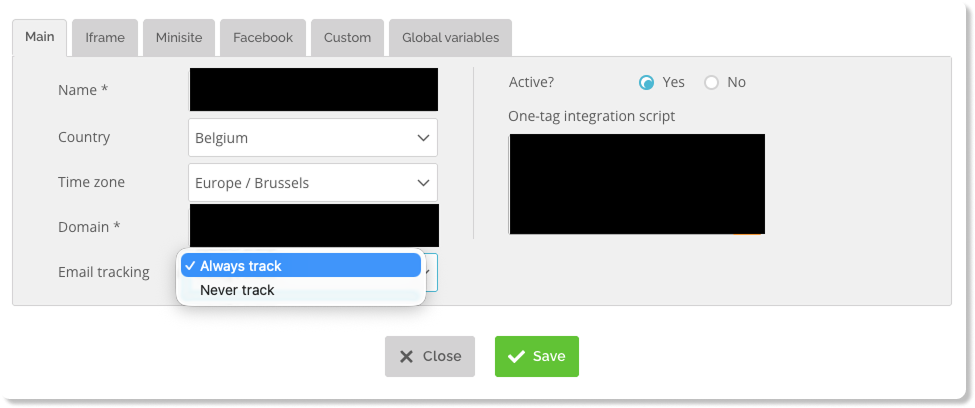
This setting applies to all campaigns and emails linked to the selected website, but does not prevent Qualifio emails from being sent. Emails will still delivered, but the related email statistics won’t be available.
💡 From 14 July 2026, Qualifio will automatically enforce this no-tracking setting on all French websites in your account. If you have websites outside of France that may also lead to emails being sent to French citizens, you may set this setting to Never track.
Coming soon to Qualifio
We are working on more updates, including:
- Granular settings that enable you to decide whether you track opens and clicks from Qualifio emails per website.
- Reflecting your tracking setting preferences in your campaign opt-ins.
- Allowing participants to withdraw tracking consent directly from Qualifio emails.
We’ll keep you posted as we roll out these improvements 🚀
Any questions? 😊 Contact your Account Manager, or get in touch with us. You can always check this FAQ article for more details.